

The heart of this battle goes to the Maastricht Treaty which formed the Eurozone. The Treaty says there will be no commingling of debts. And the German court ruled the ECB's QE program overstepped its bounds and did just that.
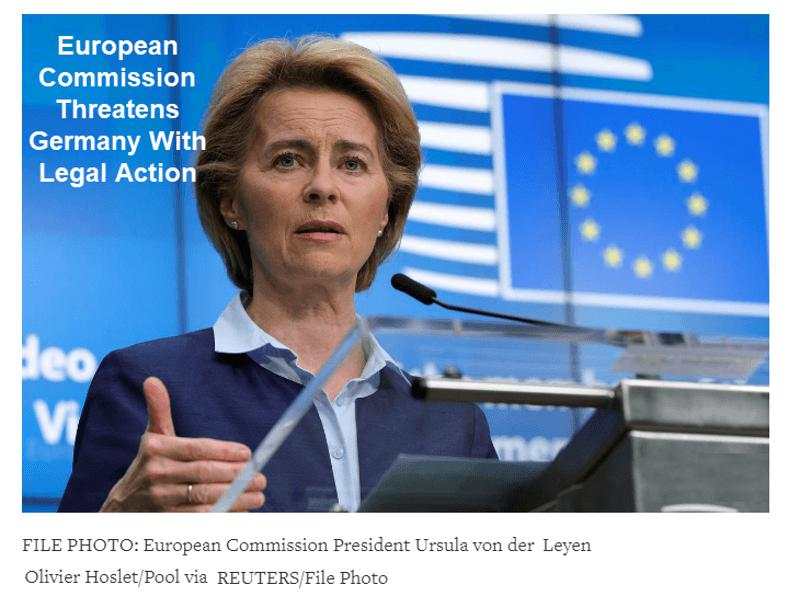
However, the European Commission, led by Ursula von der Leyen, claims that EU law holds precedence over national regulations.
The European Court of Justice’s rulings are binding for courts in the 27 member states of the block says the EC.
Thus, a major fight looms as the European Commission Threatens Germany with Legal Action.
“The recent ruling of the German Constitutional Court put under the spotlight two issues of the European Union: the euro system and the European legal system,” Leyen said in a statement.
“We are now analysing the ruling of the German Constitutional Court in detail. And we will look into possible next steps, which may include the option of infringement proceedings,” she said.Infringements are legal cases the Commission can bring before the Luxembourg-based Court of Justice of the EU, if the Brussels-based executive deems a member state is violating EU law. The court can order a nation to make amends, or face hefty fines.
Landmark Court Ruling
Eurointelligence explains What it Means for the Future of the EU.
The ruling raises complex and potentially troubling issues for the EU as a whole. The German constitutional court has accused the ECB and the CJEU, the court of Justice of the European Union, of abusing their power, and of acting beyond their assigned competences. That concept is known in German constitutional law as acting ultra vires. In the German legal interpretation of European integration, all sovereignty still rests with the member states. The EU is clearly not a federal state, but a deferred power. Member states have transferred certain rights to the EU. The German court said it accepts that it is bound by CJEU rulings, but only those that occur within the EU's agreed competences. All bets are off it the CJEU goes ultra vires. And, crucially, the German court decides if and when that happens.
This is the most serious challenge to the EU's legal framework we have yet come across. In the UK, the courts operated under the assumption that conflicts between EU and UK law would always be settled on the basis that EU law is supreme.
The ruling is unusually explicit about the breach of competences on the part of the CJEU. It criticised the CJEU's positive ruling on the asset purchases as implausible, and objectively arbitrary. It accused the EU court of an evident neglect to investigate the wider consequences of the ECB's programme. The word evident crops up many times in the ruling. It is a legally more loaded word than it appears at first sight. Moreover, the ruling accuses the CJEU of a breach of EU treaty law.
The German court's interpretation will have important consequences if other national courts follow suit, which we think is very likely. Poland's deputy justice minister already declared that member states have regained their position as the masters of the EU treaties. We expect the ruling to strengthen the determination by the Polish government to press ahead with judicial reform, and to resist interference by the EU into what they consider domestic legal affairs.
Debt Mutualization
What Germany fears now and has from the outset is "debt mutualization" in which Germany would bailout Greece, Spain, Portugal, and Italy.
That is why Germany insisted the Maastricht Treaty, which founded the Eurozone, prohibit debt mutualization.
Germany Has Had Enough
Time and time again, politicians and the ECB found ways to chip away at the treaty.
And despite the German court ruling, Pablo Iglesias, Spain's Deputy PM. says a “certain [level of] debt mutualisation is a [necessary] condition of the [continued] existence of the EU”.
Eurozone Breakup Risk at New High
Of course, the ECJ would rule that it is the high law of the land.
But then what? Fines against Germany?
Precisely who will enforce them? How?
This setup prompted my May 8 post: Eurozone Breakup Risk at New High
Bluff? Does it Matter?
I suspect the court case is a bluff and will never see the light of day. The EC will instead hope this all goes away, but it won't.
Things will keep simmering until they boil over.
Meanwhile the number of boil-over points has just risen. Add Germany to the stew.
作者:Mike “Mish” Shedlock's,文章来源FXStreet,版权归原作者所有,如有侵权请联系本人删除。
风险提示:本文所述仅代表作者个人观点,不代表 Followme 的官方立场。Followme 不对内容的准确性、完整性或可靠性作出任何保证,对于基于该内容所采取的任何行为,不承担任何责任,除非另有书面明确说明。

暂无评论,立马抢沙发