

The European Central Bank (ECB) raised all three of its policy rates by a record margin of 75 basis points on Thursday, 8th September, setting aside fears of an impending recession and concerns for citizen’s disposable incomes in an attempt to stop inflation from becoming an even greater burden across the Eurozone and its 19 member countries.
This decision helped the EUR/USD currency pair to bounce back above parity today at the time of writing, but many analysts are forecasting the pair to keep weakening, as the rate differential between Europe and the United States is expected to continue widening.
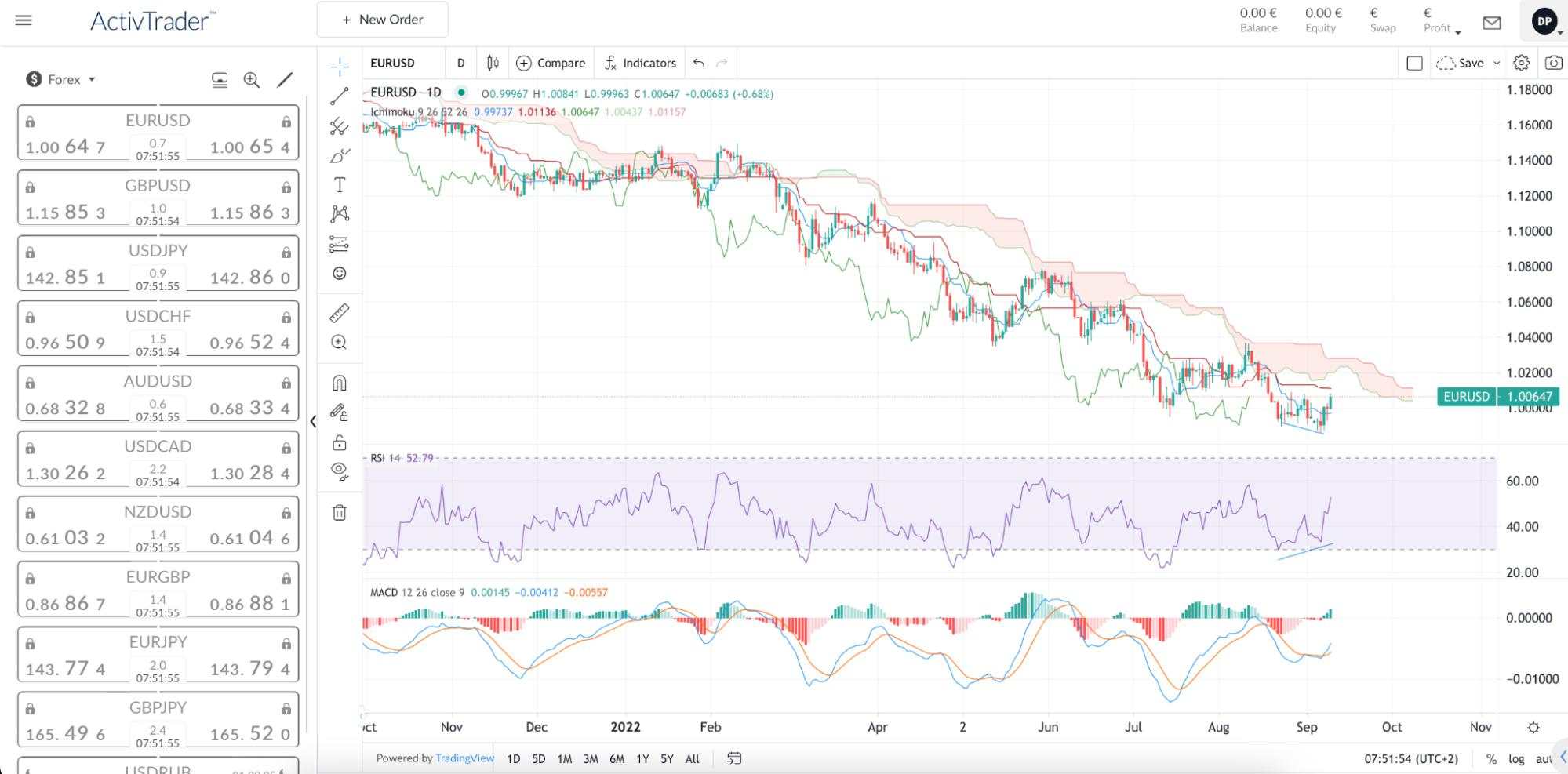
Daily EUR/USD chart - Source: ActivTrades
It’s a move that was largely expected by analysts and will bring the ECB further in line with other central banks around the world that have been busy with front-loading rate hikes earlier in the year, after many experts have criticized the Governing Council for being too slow to react to the crisis with inflation, which is now sitting at 9.1%. However, with the cost of living already spiraling from the rising energy costs, it’s an increase that will not be welcome by homeowners and borrowers in the bloc.
The benchmark rate for lending between banks for the ECB is now 1.25% in comparison to the Fed’s 2.25% to 2.5%, the Bank of England’s 1.75%, and Australia’s 2.35%.
With regard to the Asset Purchase Programme (APP) and Pandemic Emergency Purchase Programme (PEPP) intentions are still to carry on reinvesting the total principal payments from the maturing securities bought under the APP for as long as required to maintain necessary liquidity conditions and an appropriate stance for monetary policy. The Governing Council intends to reinvest the principal payments from maturing securities from the PEPP programme until the end of 2024 at the earliest.
More hikes to be expected
The European Central Bank’s President, Christine Lagarde, commented in her press conference that the Governing Council was still aiming to bring inflation back to its mandate of 2% and return to price stability in the medium term around late 2024, but warned in no uncertain terms that further rate hikes will be required over the next several meetings to prevent the current high rates of inflation from becoming entrenched in society.
“We have a goal, we have a mission. We have incredibly high inflation numbers, we are not on target in our forecast, and we have to take action,” she stated.
Citing soaring prices for food and energy, demand pressures since the economy has reopened from the pandemic, and supply bottlenecks as the main catalysts for driving up inflation, Lagarde was pessimistic about the outlook for inflation in the short term but assured her audience that it would eventually come down owing to the normalization of monetary policy.
“Looking ahead, ECB staff have significantly revised up their inflation projections and inflation is now expected to average 8.1% in 2022, 5.5% in 2023 and 2.3% in 2024.” She said.
Judging by the tone of the Governing Council’s statement, and depending on how the next round of CPI data looks (due September 16th) among other economic data to follow for the Eurozone, it possibly could become the norm for the next few meetings to have further rate increases of around this size, now that the ECB has set the precedent.
Bloomberg reported that money market traders were expecting a 60 basis points hike at the next meeting in October, with a 40% chance of a 75 basis points hike.
When asked during the press conference if future moves of this size could be expected, Lagarde wouldn’t rule out the possibility of hiking by 75 basis points again, but commented that those determinations would be made on a meeting-by-meeting basis based on incoming data.
The economic outlook
Lagarde pointed in her statement to recent economic data that showed growth in the euro area was slowing to where it may stagnate backward, with little to no growth for the later part of 2022 and the first quarter of 2023. These forecasts had caused ECB staff to revise estimates for the economic outlook for the rest of this year and into the next. Expectations are for 3.1% growth in 2022, 0.9% in 2023 and 1.9% in 2024.
According to Lagarde, this outlook is a result of high prices that are reducing the purchasing power of people’s incomes, bottlenecks with consumer products that are still causing havoc by pushing demand out of balance with supply, and a weakening of demand globally, as many other central banks lift rates and impact the terms of trade.
“In addition, the adverse geopolitical situation, especially Russia’s unjustified aggression towards Ukraine, is weighing on the confidence of businesses and consumers.” She said.
Not to mention, just days ago Europe was thrown into an even greater energy crisis as Russia completely halted the flow of gas through the main pipeline to the continent, the Nord Stream 1. A representative from the Kremlin spoke to reporters in Moscow on Monday and attributed the shutdown to the inability to conduct maintenance to the line as a result of lingering sanctions from western states including Germany and the UK. Fear is now understandably growing that there will likely be major shortages across the continent as winter looms.
Lagarde commented during her remarks that the countries choosing to implement support packages to citizens to cushion the blow of higher energy prices should ensure that they are, “temporary and targeted at the most vulnerable households and firms to limit the risk of fuelling inflationary pressures, to enhance the efficiency of public spending and to preserve debt sustainability.”
作者:Carolane de Palmas,文章来源FXStreet,版权归原作者所有,如有侵权请联系本人删除。
风险提示:本文所述仅代表作者个人观点,不代表 Followme 的官方立场。Followme 不对内容的准确性、完整性或可靠性作出任何保证,对于基于该内容所采取的任何行为,不承担任何责任,除非另有书面明确说明。

暂无评论,立马抢沙发