

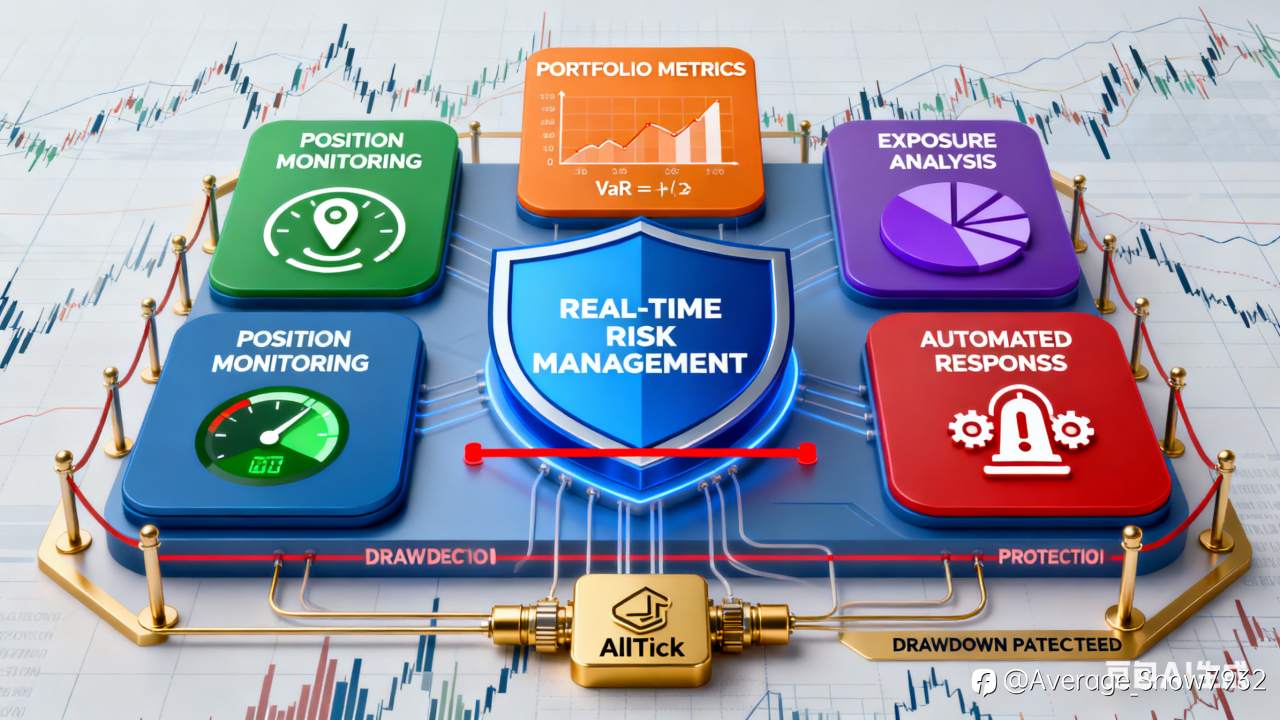
In today's interconnected financial markets, effective risk management requires real-time monitoring and immediate response capabilities. Traditional end-of-day risk reporting is no longer sufficient to protect against rapid market moves. This guide explores building comprehensive risk management systems using real-time data feeds and automated monitoring tools.
Components of a Modern Risk Management System
Real-Time Position Monitoring
Continuous tracking of all portfolio positions across asset classes:
python
class RealTimePositionMonitor:
    def __init__(self, alltick_client):
        self.client = alltick_client
        self.positions = {}
        self.risk_limits = {}

    def update_position_risk(self, symbol, position_data):
        current_price = self.client.get_current_price(symbol)
        position_value = position_data['quantity'] * current_price

        # Calculate real-time P&L
        unrealized_pnl = position_value - position_data['cost_basis']
        pnl_percent = unrealized_pnl / position_data['cost_basis']

        self.positions[symbol].update({
            'current_value': position_value,
            'unrealized_pnl': unrealized_pnl,
            'pnl_percent': pnl_percent,
            'last_updated': datetime.utcnow()
        })

        return self.check_risk_limits(symbol)

    def check_risk_limits(self, symbol):
        violations = []
        position = self.positions[symbol]

        # Position-level limits
        if abs(position['unrealized_pnl']) > self.risk_limits['max_position_loss']:
            violations.append('POSITION_LOSS_LIMIT')

        if position['current_value'] > self.risk_limits['max_position_size']:
            violations.append('POSITION_SIZE_LIMIT')

        return violations
Portfolio-Level Risk Metrics
Value at Risk (VaR) Calculation
python
class PortfolioVaRCalculator:
    def __init__(self, alltick_client, confidence_level=0.95):
        self.client = alltick_client
        self.confidence = confidence_level

    def calculate_real_time_var(self, portfolio):
        # Get recent returns for all positions
        returns_data = {}
        for symbol, position in portfolio.items():
            historical_prices = self.client.get_historical_data(
                symbol, '1d', 100
            )
            returns = historical_prices['close'].pct_change().dropna()
            returns_data[symbol] = returns

        # Calculate portfolio VaR
        portfolio_returns = self.calculate_portfolio_returns(
            returns_data, portfolio
        )

        var = np.percentile(portfolio_returns, (1 - self.confidence) * 100)
        return abs(var * portfolio.total_value)

    def calculate_portfolio_returns(self, returns_data, portfolio):
        # Weight returns by position size
        weighted_returns = []
        total_value = portfolio.total_value

        for symbol, returns in returns_data.items():
            weight = portfolio[symbol]['current_value'] / total_value
            weighted_returns.append(returns * weight)

        return pd.concat(weighted_returns, axis=1).sum(axis=1)
Exposure Analysis and Concentration Risk
Sector and Asset Class Exposure
python
class ExposureAnalyzer:
    def __init__(self, alltick_client):
        self.client = alltick_client

    def analyze_sector_exposure(self, portfolio):
        sector_exposure = {}

        for symbol, position in portfolio.items():
            # Get instrument sector classification
            instrument_info = self.client.get_instrument_info(symbol)
            sector = instrument_info.get('sector', 'Unknown')

            # Aggregate exposure by sector
            if sector not in sector_exposure:
                sector_exposure[sector] = 0
            sector_exposure[sector] += position['current_value']

        return self.calculate_concentration_metrics(sector_exposure)

    def calculate_concentration_metrics(self, sector_exposure):
        total_value = sum(sector_exposure.values())
        metrics = {
            'herfindahl_index': sum((exp/total_value)**2
                                  for exp in sector_exposure.values()),
            'max_sector_exposure': max(sector_exposure.values()) / total_value,
            'sector_breakdown': {sector: exp/total_value
                               for sector, exp in sector_exposure.items()}
        }
        return metrics
Real-Time Alerting and Automated Controls
Risk Threshold Monitoring
- Position-level loss limits and concentration thresholds
- Portfolio-wide VaR and drawdown limits
- Correlation breakdown alerts during stress periods
- Liquidity and margin requirement monitoring
Automated Risk Responses
python
class AutomatedRiskManager:
    def __init__(self, alltick_client, trading_api):
        self.client = alltick_client
        self.trading_api = trading_api
        self.alert_history = []

    def monitor_and_respond(self):
        risk_signals = self.assess_portfolio_risk()

        for signal in risk_signals:
            if signal['severity'] == 'CRITICAL':
                self.execute_emergency_protocol(signal)
            elif signal['severity'] == 'HIGH':
                self.initiate_risk_reduction(signal)
            elif signal['severity'] == 'MEDIUM':
                self.send_alert(signal)

    def execute_emergency_protocol(self, risk_signal):
        # Immediate position reduction
        if risk_signal['type'] == 'DRAWDOWN_BREACH':
            self.reduce_portfolio_exposure(0.5)  # Reduce by 50%
        elif risk_signal['type'] == 'VAR_BREACH':
            self.hedge_portfolio(risk_signal)
        elif risk_signal['type'] == 'LIQUIDITY_CRISIS':
            self.convert_to_cash()
AllTick Integration for Comprehensive Risk Management
Real-Time Data Feeds for Risk Calculation
- Live pricing across all positions for accurate P&L
- Volatility data for dynamic VaR calculations
- Correlation matrices for portfolio diversification analysis
- Liquidity metrics for position exit feasibility
Historical Data for Stress Testing
python
class StressTestEngine:
    def __init__(self, alltick_client):
        self.client = alltick_client

    def run_historical_stress_test(self, portfolio, crisis_periods):
        results = {}

        for period_name, dates in crisis_periods.items():
            # Get historical data for crisis period
            crisis_data = self.client.get_historical_range(
                symbols=portfolio.symbols,
                start_date=dates['start'],
                end_date=dates['end']
            )

            # Simulate portfolio performance
            simulated_pnl = self.simulate_period_performance(
                portfolio, crisis_data
            )

            results[period_name] = {
                'max_drawdown': simulated_pnl.min(),
                'recovery_period': self.calculate_recovery(simulated_pnl),
                'stress_var': self.calculate_stress_var(simulated_pnl)
            }

        return results
Best Practices for Risk System Implementation
Gradual Implementation Strategy
- Start with basic position monitoring and alerts
- Add portfolio-level risk metrics as system matures
- Implement automated controls with manual override
- Regular backtesting of risk protocols
Continuous Improvement Cycle
- Regular review of risk limits and thresholds
- Stress testing against new crisis scenarios
- Incorporation of new risk factors and metrics
- Performance analysis of risk mitigation actions
Effective risk management in modern markets requires real-time monitoring, comprehensive analytics, and automated response capabilities. By leveraging AllTick's robust data infrastructure, institutions can build risk systems that provide continuous protection while supporting informed decision-making.
Build your institutional-grade risk management system with AllTick's comprehensive data solutions. Protect your portfolio at https://alltick.co/
风险提示:本文所述仅代表作者个人观点,不代表 Followme 的官方立场。Followme 不对内容的准确性、完整性或可靠性作出任何保证,对于基于该内容所采取的任何行为,不承担任何责任,除非另有书面明确说明。

暂无评论,立马抢沙发