


· 阅读量 14,693
A Practical Guide for Traders
Before you worry about entries, exits and indicators, there’s a more basic question you should be clear about as a trader:
How does my broker actually earn money from me?
Once you understand this, it becomes much easier to judge whether a broker’s offer is fair, how expensive your trading really is, and where hidden conflicts of interest might exist.
In general, forex brokers make money through six main channels:
-
Spreads
-
Commissions
-
Swap rates (rollover fees)
-
Their execution model (ECN/STP vs Market Maker)
-
Extra fees and charges
-
Affiliate and referral programs
1. Spreads – The “Built-In” Cost on Every Trade
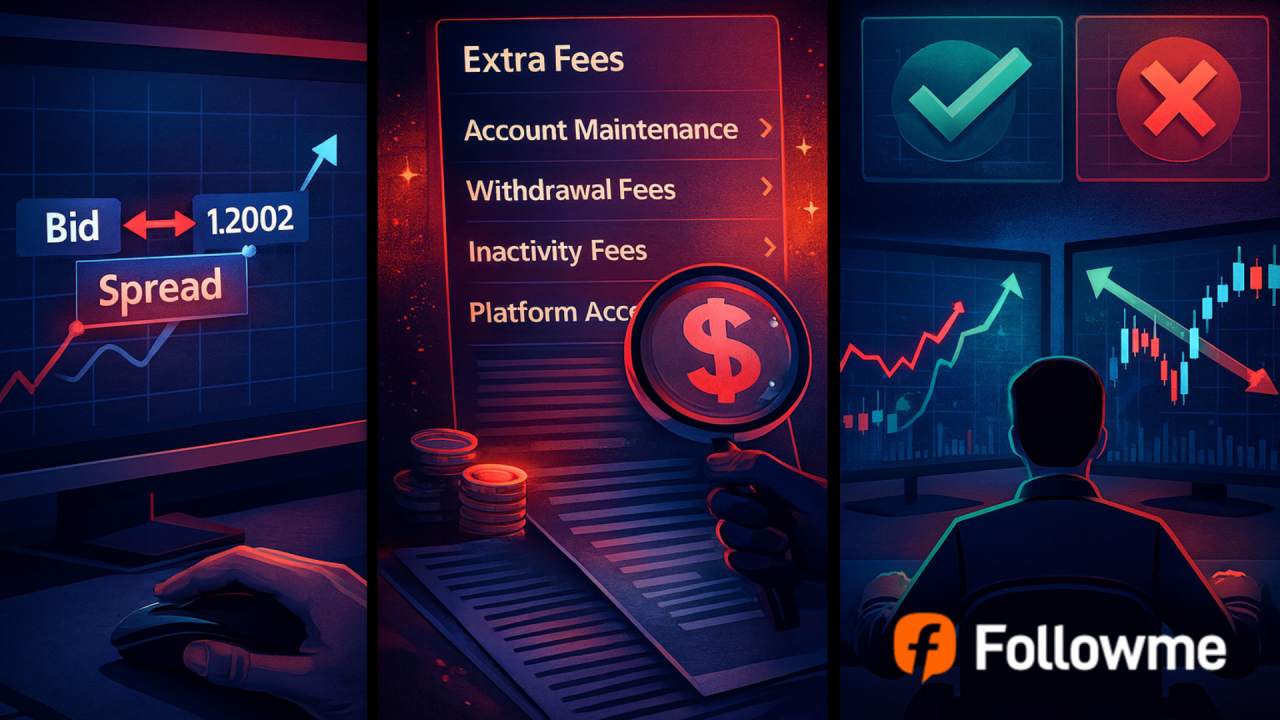
The spread is the difference between the bid (sell) price and the ask (buy) price. For most forex brokers, this is the primary source of revenue.
Imagine EUR/USD is quoted as:
-
Bid: 1.2000
-
Ask: 1.2002
The spread is 2 pips. When you open a trade, you buy at the higher ask price or sell at the lower bid price, so you immediately see a small unrealised loss. That initial loss is the spread you just paid.
Behind the scenes, brokers typically receive tighter raw spreads from their liquidity providers (large banks and financial institutions). They then add a markup before streaming prices to clients. This markup – the difference between the raw spread and the spread you see – is part of the broker’s profit on each trade.

2. Commissions – When You Pay Per Trade
The second classic way brokers earn is through commissions charged on each trade you execute.
Most brokers offer two broad pricing models:
Commission-based accounts usually come with:
-
Very tight raw spreads that are close to interbank levels, and
-
A clearly stated commission per trade.
Commission-free accounts work differently:
-
You do not see a separate commission charge, but
-
The spread is wider, and that spread includes the broker’s entire markup.
Neither structure is automatically “cheaper.” What matters is the effective total you pay:
Total cost = Spread cost + Commission + Any additional fees
3. Swap Rates (Rollover) – The Cost of Holding Positions Overnight
Whenever you hold a forex position overnight, you are effectively:
-
Borrowing one currency and Lending another.
The difference between the two interest rates appears as a swap (or rollover). This shows up on your account as either:
-
A positive swap: you earn a small amount each night, or
-
A negative swap: you pay a small amount each night.
Over weeks and months, swaps can become a meaningful factor:
-
If you are a swing or position trader, positive swaps can provide an additional source of income when holding trades for longer periods.
-
If you frequently hold positions with large negative swaps, you are quietly increasing your cost of doing business every single day.
Key takeaway:
Swaps may look small trade by trade, but they add up. For longer-term traders especially, ignoring swaps can mean misunderstanding your true profitability.
4. Swap Rates (Rollover) – The Cost of Holding Positions Overnight
The way your broker routes your orders also affects how they make money, and whether your losses can become their direct profits.
ECN / STP (A-Book) Brokers:
When a broker truly runs an A-book, it does not take the opposite side of your trades as principal. Instead, it typically earns from:
- Markups on the raw spreads from liquidity providers, and/or
- Commissions based on your trading volume.
In other words, its business is to facilitate trading and earn from turnover, not from your losses.
Market Makers (B-Book) Brokers:
Market-making brokers quote prices to you directly and often do not hedge every trade externally. When your trades are kept on the B-book:
- Your losses can become the broker’s profits, and
- Your profits are their cost, paid from their own capital.
Because many retail traders lose money over time, a well-run B-book can be very profitable, which is why many firms use a hybrid model and internalise the rest based on client behaviour, trade size and risk analytics.
5. Extra Fees and Charges – The “Small Print” Revenue
Beyond spreads, commissions and swaps, brokers may also earn from non-trading fees. Individually, these charges can seem minor, but across thousands of accounts, they contribute noticeably to revenue.
Common examples include: Account Maintenance Fees, Withdrawal Fees, Inactivity Fees, Platform and Tool Access Fees.
Common examples include: Account Maintenance Fees, Withdrawal Fees, Inactivity Fees, Platform and Tool Access Fees.
6. Affiliate and Referral Programs – When Others Bring Clients In
These programmes do not directly charge you, but they influence how aggressively some people promote specific brokers.
6.1 Affiliate Programs
In an affiliate model:
-
Third-party individuals or companies promote the broker,
-
They receive a unique tracking link or code, and
-
When new clients register and start trading through that link, the affiliate earns commission.
This commission often comes from a share of the spread or commission you pay, or from a set cost-per-acquisition paid by the broker.
6.2 Referral Programs
Referral programmes are similar but usually more informal:
-
Existing clients recommend the broker to friends or contacts,
-
The referrer receives a bonus, rebate or reward once the new client deposits or trades.
From the broker’s perspective, these programmes are a marketing cost built into their overall business model. They help the firm grow its client base at scale.
What This Means for You as a Trader
Understanding how a broker makes money isn’t just theory, it should guide which broker you choose and how you use them.
Always ask:
- Do they earn mainly from transparent spreads and commissions, or are they heavily profiting from B-book client losses?
- Are all costs including spreads, commissions, swaps, withdrawal and inactivity fees, clearly disclosed, or buried in the fine print?
- Does their pricing structure actually match your style (frequent trading vs long-term holding)?
When you think this way, you stop being a passive user of a platform and start behaving like a client consciously selecting a financial partner.
风险提示:本文所述仅代表作者个人观点,不代表 Followme 的官方立场。Followme 不对内容的准确性、完整性或可靠性作出任何保证,对于基于该内容所采取的任何行为,不承担任何责任,除非另有书面明确说明。
喜欢的话,赞赏支持一下

暂无评论,立马抢沙发