


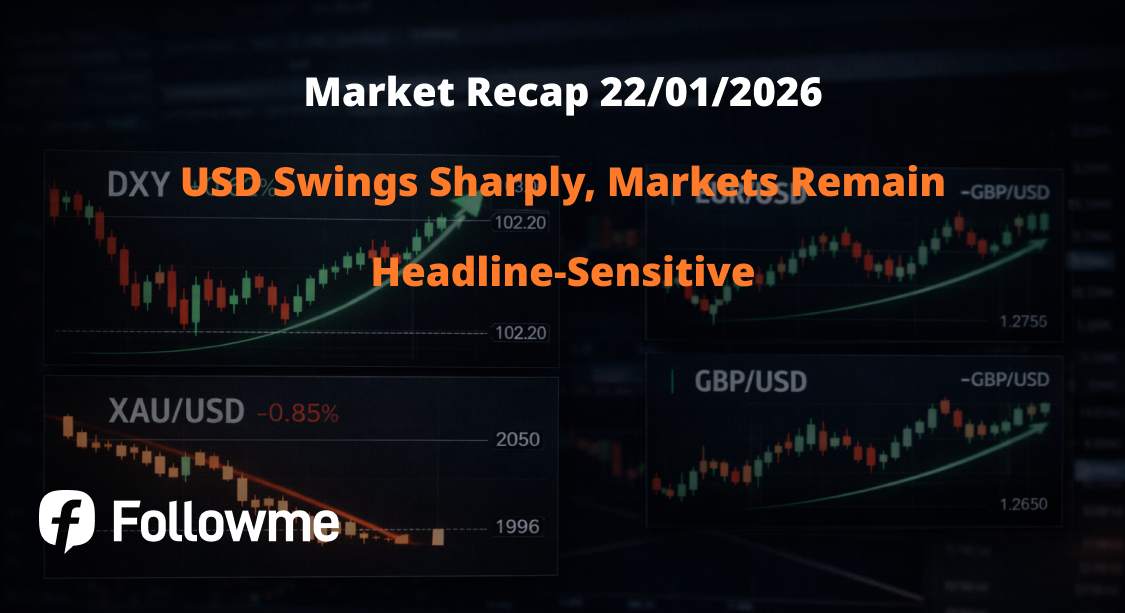
Forex Focus & Short-Term Trading Outlook for Traders
Global financial markets today remain headline-sensitive, as investors continue rotating between two extremes: risk-off (defensive positioning) and rebalancing. In this context, the FX market is seeing clear volatility across major currencies, with the USD fluctuating in response to rate expectations and risk sentiment, while more sentiment-sensitive currencies such as AUD/NZD trade more cautiously.
Key point: price ranges remain wide and the market has not established a clear one-directional trend. This is the type of environment where stop hunts and fast intraday reversals are more likely.
1) Main driver of the day: USD swings on rate expectations and risk sentiment
The USD remains at the center of attention. Intraday moves are primarily driven by:
-
expectations around the interest-rate path;
-
policy/geopolitical headlines;
-
risk appetite in equities and commodities.
In a headline-driven market regime, traders should avoid emotional entries and instead prioritize discipline and confirmation.
2) Gold and oil remain key sentiment barometers
Gold continues to act as a defensive sentiment indicator. When gold rallies strongly, it often signals stronger safe-haven demand and the USD may weaken; when gold pulls back, markets typically shift back into a more balanced state.
Oil is highly sensitive to geopolitical news and growth expectations. Oil volatility indirectly impacts inflation expectations, which then feeds back into USD pricing.
Forex outlook (24–48h): Scenario-based execution
A) USD (DXY): prioritize zone-based “sell rallies / buy dips”
In an unclear-trend environment, the most effective approach is often:
-
wait for USD to rally into resistance zones and look for selling pressure (sell rallies), or
-
wait for USD to dip into support zones with a clear reaction and look for rebound trades (buy dips),
depending on intraday structure.
Avoid chasing breakouts without confirmation, as false-break risk remains high.
B) EURUSD: tends to follow USD — trade zones rather than predictions
-
If USD strengthens, EURUSD is likely to face further downside correction.
-
If USD weakens again on headlines, EURUSD can rebound quickly.
Recommendation: trade around key support/resistance levels, prioritizing break-and-retest structures or reversal signals at zones.
C) GBPUSD: higher volatility than EURUSD — reduce position size
GBPUSD is typically more sensitive to USD swings and may trade with wider intraday ranges.
Preferred approach: wait for pullbacks into key support/resistance zones and enter only with confirmation.
D) USDJPY: high-risk pair in volatile conditions
USDJPY is prone to stop sweeps when yields are volatile.
Recommendation: participate only when structure is clear; avoid emotional scalping.
E) AUDUSD/NZDUSD: highly dependent on risk-on/risk-off regime
-
If equities stabilize and risk sentiment improves, AUD/NZD can recover.
-
If markets return to a defensive mode, these currencies tend to weaken again.
Conclusion
23/01/2026 remains a headline-sensitive session, with unclear trend direction and multiple large intraday swings. In FX, the USD is still the main variable driving EURUSD/GBPUSD and amplifying volatility in USDJPY.
Most suitable strategy today: trade by scenarios, prioritize key price zones, reduce leverage/position size, and strengthen risk management discipline.
风险提示:本文所述仅代表作者个人观点,不代表 Followme 的官方立场。Followme 不对内容的准确性、完整性或可靠性作出任何保证,对于基于该内容所采取的任何行为,不承担任何责任,除非另有书面明确说明。

暂无评论,立马抢沙发