

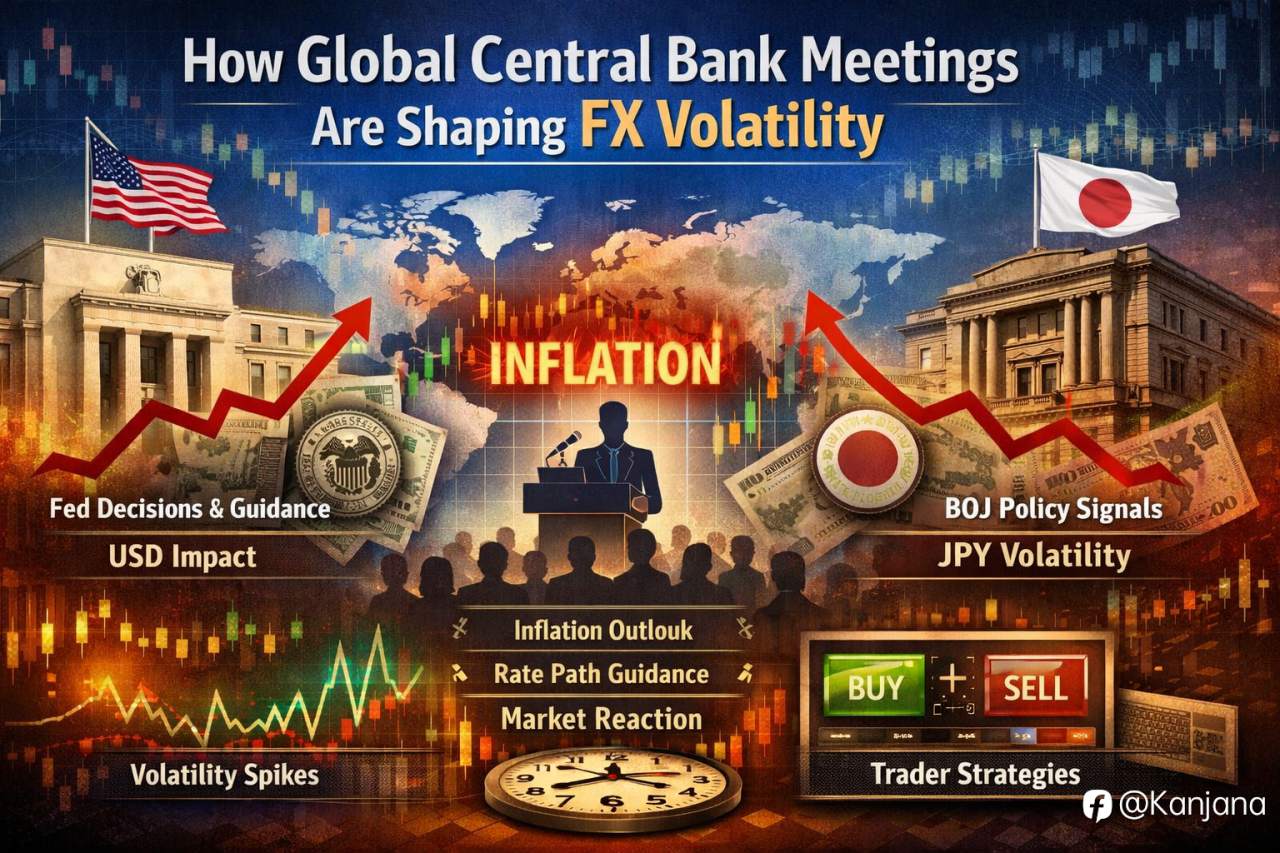
Global financial markets remain highly sensitive to central bank communication, as inflation dynamics and interest rate policies continue to define currency valuation across major FX pairs. In the current environment, central bank meetings are not just routine events they are key volatility triggers.
Decisions and forward guidance from major institutions such as the Federal Reserve (Fed) and the Bank of Japan (BOJ) are closely monitored, particularly when policy rates are expected to be held steady or when subtle shifts in tone suggest a potential change in future direction.
Why Central Bank Communication Matters More Than the Rate Decision
In many cases, the interest rate decision itself is already priced into the market. What truly moves currencies is how central banks frame their outlook.
Key elements traders focus on include:
- Inflation projections and risk assessment
- Forward guidance on future rate paths
- Language changes in policy statements
- Comments during press conferences and Q&A sessions
Even when rates remain unchanged, a more hawkish or dovish tone can rapidly reprice expectations and trigger sharp moves in FX markets.
Federal Reserve (Fed): Inflation Credibility and USD Sensitivity
The U.S. dollar remains the most influential currency globally, making Fed communication a primary driver of overall FX direction.
Current market sensitivity revolves around:
- Whether inflation is converging sustainably toward target
- How long restrictive policy will remain in place
- The balance between inflation control and economic growth risks
When the Fed signals patience or confidence in current policy, USD reactions can be muted. However, any shift in language regarding inflation risks or labor market conditions often results in immediate USD volatility across multiple pairs.
Bank of Japan (BOJ): Policy Normalization and JPY Volatility
The BOJ continues to be a unique case among major central banks. Even minor adjustments in policy stance or yield guidance can have outsized effects on the Japanese yen.
Key risk factors include:
- Speculation around policy normalization
- Yield curve control adjustments
- Government and Ministry of Finance commentary on FX stability
As a result, JPY pairs often experience sharp, two way moves around BOJ meetings, making disciplined execution essential for traders.
Market Reaction Patterns Around Central Bank Meetings
Historically, FX markets tend to exhibit the following behaviors during central bank events:
- Elevated volatility before and immediately after announcements
- False breakouts and stop loss sweeps
- Directional moves driven more by expectations than data
This reinforces the importance of waiting for confirmation rather than reacting impulsively to initial price spikes.
Trading Considerations in a Central Bank Driven Environment
When central banks dominate market narratives, traders may consider the following principles:
- Reduce position size ahead of major meetings
- Avoid overexposure to correlated pairs
- Trade post announcement structure, not headlines
- Focus on key levels and reaction zones rather than predictions
In many cases, the best trade is patience allowing the market to reveal its true direction after initial volatility fades.
Conclusion
Global central bank meetings remain a core driver of FX volatility, even in periods when interest rates are expected to remain unchanged. Policy communication, inflation outlooks, and subtle shifts in tone from institutions like the Fed and BOJ can significantly reshape currency trends in a short period of time.
For traders, success in this environment depends not on anticipating outcomes, but on understanding market expectations, managing risk effectively, and responding with discipline once clarity emerges.
风险提示:本文所述仅代表作者个人观点,不代表 Followme 的官方立场。Followme 不对内容的准确性、完整性或可靠性作出任何保证,对于基于该内容所采取的任何行为,不承担任何责任,除非另有书面明确说明。


-THE END-