

If you’ve been reading our Beginner’s Guide to Prop Firms, so far, you’ve learned:
- What prop firms are (Lesson 1).
- The myths vs. realities of prop firms (Lesson 2).
- How prop firms make money (Lesson 3).
- The prop firm industry ecosystem (Lesson 4).
- Why some prop firms are scams (Lesson 5).
- Why other prop firms can be legitimate (Lesson 6).
The natural question is: “Okay… but can I actually succeed with a prop firm?”
The short answer: Yes, but it’s rare and extremely difficult. Success requires a mix of skill, discipline, mindset, and strategy.
This lesson will show you what it takes to join the small group of traders (the 1–2%) who not only pass challenges but also consistently receive payouts.
Defining Success with Prop Firms
First, let’s clarify what “success” means in this context.

Is it owning a luxury yacht? A nice car? A helicopter? Probably not.
Success could mean:
-
Passing a Challenge
- Many beginners think success = passing once.
- But passing without long-term profitability is short-lived.
-
Getting a Payout
- A stronger definition is withdrawing profits at least once.
-
Consistent Payouts
- The gold standard is collecting multiple payouts over time, showing sustainable performance.
-
Scaling Beyond Prop Firms
- The ultimate success is using prop firms as a stepping stone to build your own capital.
📖 For this lesson, we’ll focus on consistent payouts as the true marker of prop firm success.
The Harsh Reality: Success Rates

Industry data suggests:
- 5–10% of traders pass the initial evaluation.
- 1–2% go on to collect multiple payouts.
- Fewer still achieve consistent, long-term success.
That doesn’t mean it’s impossible. But it does mean you need to approach prop firms with a professional mindset rather than a gambler’s hope.
Traits of Consistently Profitable Prop Traders

What separates the few who succeed from the many who fail? Common traits include:
1. Risk Management First
- Never risking more than 0.5–1% per trade.
- Always respecting daily and overall drawdown limits.
2. Patience and Discipline
- Waiting for high-quality setups instead of forcing trades.
- Avoiding overtrading to hit targets quickly.
3. Emotional Control
- Handling pressure without revenge trading.
- Accepting losses calmly and sticking to the plan.
4. Business Mindset
- Viewing prop trading as a business, not a lottery.
- Tracking costs, risks, and expected returns.
5. Process Orientation
- Journaling trades, analyzing performance, and improving continuously.
💎Successful prop traders treat trading like a serious profession, not a side hustle.
Best Practices for Prop Firm Success
1. Start Small
Why this matters: Spreading yourself too thin increases costs and divides your focus.
What to do:
- Choose ONE prop firm to start with. Research companies with clear rules and good payout histories
- Select the smallest account size available (typically $10,000-$25,000)
Beginner tip: Look for firms with “balance-based” drawdown rather than “equity-based” since this gives you more flexibility as it only counts closed trades, not floating losses.
2. Master the Rules Before You Trade
Understand the prop firm’s rules:
- Daily Drawdown (typically 5%): This is the maximum you can lose in a single day. And it’s calculated continuously throughout the day, not just at close. If your account drops 5% at any point (even if you later recover), you fail.
- Maximum Drawdown (typically 10%): The total amount your account can drop from its starting balance.
- Profit Targets: Usually 5-10% to pass challenges, often in multiple phases.
- Time Limits: Some firms have minimum trading days; others have no time restrictions.
What to do:
- Write down ALL rules for your chosen firm. Make sure to read the FINE PRINT to spot any “hidden” rules.
- Calculate your dollar amounts: On a $10,000 account with 5% daily drawdown, you can lose a maximum $500 in a day.
- Set your own limits at 3-4% to have a safety buffer.
- Know which drawdown type your firm uses (balance-based vs equity-based).
3. Trade Conservatively
The math that matters: Traders who risk less than 2% per trade have 40% higher success rates.
What conservative trading looks like:
- Risk per trade: Maximum 1-2% of your account balance per trade
- Daily risk limit: Stop trading after losing 2-3% in a day (well before the 5% limit)
- Target weekly gains: 1-2% weekly is sustainable; chasing 5-10% weekly leads to blown accounts
- Position sizing: On a $10,000 account risking 1%, your maximum loss per trade is $100
Example strategy:
- Week 1: Target $100-200 profit (1-2%)
- Week 2: Target $100-200 profit
- Week 3: Target $100-200 profit
- Week 4: Target $100-200 profit
- Total: $400-800/month = 4-8% monthly.
This passes most challenges while keeping risk manageable.
Most prop firm Phase 1 challenges require 8-10% profit. At this pace, you’d pass in 4-6 weeks while staying well within drawdown limits.
Compare that to traders chasing 5-10% weekly gains. They might hit it once or twice, but they almost always blow up before reaching the target.
Avoid: Taking large positions hoping to pass quickly. This is the #1 reason traders fail.
4. Respect the Psychological Game
Understanding the challenge design: Prop firms design challenges to identify disciplined traders who can manage emotions under pressure. The rules create stress intentionally.
Mental strategies:
- Accept slow progress: Passing in 1-2 months is normal and healthy.
- Journal your emotions: Write down how you feel before, during, and after trades.
- Take breaks: If you lose 1-2% in a day, stop trading and analyze what happened.
- Celebrate small wins: Each profitable day is progress.
- Expect losing days: Even successful traders have them.
Red flags you’re trading emotionally:
- Increasing position size after losses (revenge trading).
- Trading outside your plan.
- Feeling anxious or excited (good trading should feel boring).
- Checking your account constantly.
5. Budget Realistically for Multiple Attempts
The average trader spends around $4,270 on challenges before getting funded. So ideally, you spend less than that!
Here’s how to approach this:
Financial planning:
- Challenge fees typically range from $50-$1,000+, depending on account size.
- Budget for 3-5 attempts minimum before expecting success.
- Example: If a $10,000 challenge costs $100, set aside $300-500 for attempts.
- Consider this an investment in your trading education, not a guaranteed return.
Smart approach:
- Start with the cheapest challenge available.
- Practice your strategy in a demo account for 30+ days first.
- Only attempt a live challenge when you’ve been profitable for 30 consecutive days in demo.
- Ensure that the market volatility before you start your challenge closely matches the conditions under which you proved your profitability.
- If volatility has changed, either wait for it to normalize or continue practicing in a demo account until you have successfully adapted to the new environment.
- Don’t attempt a new challenge immediately after failing. Analyze what went wrong first.
6. Prioritize Your First Payout
Why this matters: Only 1-2% of traders who get funded maintain their accounts long-term. Getting that first payout builds momentum.
Strategy for funded accounts:
- First goal: Secure a payout (typically available after 30 days and reaching minimum profit).
- Many firms offer fee refunds after your first payout. This covers your challenge costs.
- Don’t get aggressive: Trade the same conservative strategy that got you funded.
- Profit target: Aim for that same 1-2% weekly until you get your first withdrawal.
After first payout:
- You can gradually increase position sizes as you scale.
- Build confidence through consistent small wins.
- Consider attempting larger account sizes once you’ve proven consistency.
Common Mistakes That Lead to Failure

Even skilled traders fail prop firm challenges because they:
- Overtrade to hit profit targets quickly.
- Break rules by accident (e.g., news trading restrictions).
- Revenge trade after hitting losses.
- Over-leverage to speed up growth.
- Chase scaling promises without first proving consistency.
💎 Avoiding these mistakes is often the difference between failure and payout.
Psychology > Risk Management > Strategy
Many beginners think success = having a great trading strategy.
While strategy matters, it’s only one piece of the puzzle. Most failures stem from poor risk management and psychological weaknesses rather than flawed strategies.
The Three Pillars of Trading Success
- Strategy provides your edge in the market (a statistical advantage over time).
- Risk Management keeps you solvent through inevitable losing streaks.
- Psychology determines whether you can actually follow your rules when it counts.
Consider this example: A trader with a 55% win-rate system can blow their account through over-leveraging, while a trader with a 45% win-rate but disciplined risk management can remain profitable long-term.
💎 Success is less about finding the “perfect” system and more about executing consistently under pressure.
What Prop Firms Really Test
This is worth repeating: Prop firms aren’t just filtering for profitable strategies, they’re identifying traders who can follow their own rules when emotions run high.
To pass their evaluations, you need:
- Reproducible entry and exit criteria.
- Consistent position sizing across all trades.
- Emotional resilience during drawdowns.
Before You Buy a Challenge
If you don’t yet have this foundation in place, don’t purchase a prop firm challenge!
Instead, build these skills using free trial accounts or personal demo trading. Only when you’ve proven you can execute with discipline should you invest in funded evaluations.
Practical Plan for Success
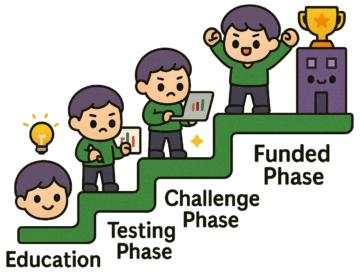
Here’s a beginner-friendly plan:
-
Education Phase
- Learn the basics of trading, such as price action, market structure, risk management, trading strategy development, and psychology.
- Practice on demo accounts.
-
Testing Phase
- Backtest your strategy.
- Track results in a journal.
- Confirm consistency over at least 3 months.
-
Challenge Phase
- Start with one firm and one account.
- Trade conservatively, prioritize rule adherence.
-
Funded Phase
- Secure the first payout quickly.
- Scale carefully, don’t rush.
-
Expansion Phase
- Diversify across multiple firms.
- Use prop income to build personal trading capital.
💎 The end goal: independence. Prop firms are stepping stones to building your own personal trading account.
Case Study: Trader Mindset in Action
Imagine two traders taking a $100,000 challenge:
Justin wants to hit 8% in one week.
- Risks 5% on one trade.
- Gets stopped out → challenge failed.
Hailey wants to hit 8% in 30 days.
- Risks 0.5% per trade.
- Aims for 1–2% per week.
- Passes in 4 weeks with minimal stress.
Same account size, same rules. Different outcomes, all based on mindset and risk management.
The Limitations of Prop Firm Success
Even if you pass the challenge and get funded, you’ll face two big limitations that most beginners don’t anticipate:
1. Firm Stability is Your Biggest Risk
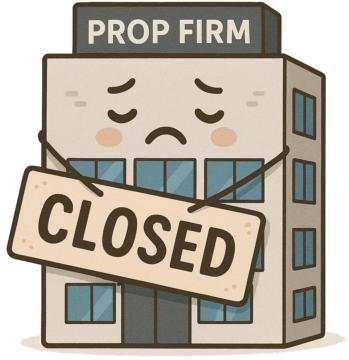
- Your trading income doesn’t just depend on your performance. It depends on your prop firm staying in business. Between 80-100 prop firms shut down in 2024 alone, locking traders out of accounts and withholding earned payouts.
- Warning signs: Red flags include delayed payouts, retroactive rule changes, and vague violation terms. Even profitable traders lost everything when the firms they used ceased operations in 2024.
- Protection strategy: Successful traders use multiple prop firms to diversify risk. Withdraw profits frequently and thoroughly research firm stability before investing in challenges.
2. Strict Rules Constrain Your Trading

You’ll face far more restrictions than just drawdown limits.
- Many firms ban trading 1-5 minutes before/after news events, with some capping news trading profits at just 40%.
- The “1% Hidden Risk Ceiling” that limits the maximum risk per trade or position to 1% of the trading account’s balance, even if this cap is not prominently advertised or is buried in the prop firm’s documentation.
- Other common restrictions include minimum trading days (5-10 days), overnight trade prohibitions, strategy limitations on EAs/copy trading, and leverage caps.
Key Takeaways

- Yes, you can succeed with prop firms, but only with skill, discipline, and realistic expectations.
- Success = consistent payouts, not just passing a challenge once.
- Success requires years of skill development, just like any other high-performance profession.
- Traits of successful traders: risk management, discipline, emotional control, and business mindset.
- Best practices: start small, master rules, trade conservatively, budget for retries, secure payouts.
- Avoid common mistakes: overtrading, rule-breaking, and emotional decisions.
- Prop firms should be viewed as stepping stones. Your ultimate goal should be building enough capital to trade independently with complete freedom.
Prop firm challenges are about proving your discipline under constraints.
The marketing emphasizes big funding numbers, but the true game is surviving inside tight risk management rules while trading consistently.
For prepared traders, prop firms can accelerate capital growth. For unprepared ones, they are expensive lessons in humility.
We’ve answered the big question:
Yes, success with prop firms is achievable, but only if you approach them with strict discipline and genuine respect for their rules and processes.
In the next lesson, we’ll walk you through building a concrete risk management plan so you’re not just another statistic funding the prop firm ecosystem.Whether you’re a scalper or swing trader, you’ll walk away with an actionable plan that protects your account and dramatically increases your odds of actually getting funded.

暂无评论,立马抢沙发