

Unless you’re still very much in holiday mode, you probably saw the news of the U.S. military capturing Venezuela’s President in a dramatic high-stakes raid over the weekend.
President Trump even announced that the U.S. will run the country, prompting massive international uproar and an emergency meeting by the UN Security Council.
Now Venezuela has the world’s largest proven oil reserves, even more than Saudi Arabia, so this should be a big deal for oil prices, right?
Except oil barely budged. WTI crude still sits around $57 per barrel while Brent hovers near $61, basically flat since the Venezuela crisis began.
If you’re scratching your head wondering why a major geopolitical event involving oil-rich Venezuela isn’t spiking prices, you’re not alone.
What Happened: The Venezuela Crisis Explained
Back in December last year, the U.S. already began a maritime blockade, seizing oil tankers carrying Venezuelan crude. The sanctions forced Venezuela to shut wells as storage filled up, cutting production further.
On January 3, 2026, U.S. forces conducted a military operation in Venezuela, capturing President Nicolás Maduro and his wife then taking them to New York to face narcoterrorism charges. President Trump announced the U.S. would temporarily “run” Venezuela and invited American oil companies to invest billions to rebuild the country’s broken oil infrastructure.
Venezuela matters because of what’s underground: 303 billion barrels of proven oil reserves, about 17% of the world’s total. That’s more than Saudi Arabia’s 267 billion barrels. The Orinoco Belt alone holds massive quantities of extra-heavy crude.But here’s the catch: Venezuela currently produces only about 1 million barrels per day. That’s less than 1% of global oil production. Back in the late 1990s, Venezuela pumped over 3 million barrels daily. Decades of mismanagement, corruption, and U.S. sanctions reduced output to a fraction of its former capacity.
Why Oil Markets Barely Reacted
Oil moved about 1% higher on Monday after the raid, then settled back down. That tiny reaction tells you everything about how oil markets actually work versus how people think they work.
The market is already oversupplied. Global oil production exceeded demand by about 2 million barrels per day in 2025, and analysts expect that surplus to balloon to nearly 4 million barrels per day in 2026. Plus the U.S., Brazil, Canada, Guyana, and Saudi Arabia are all producing at or near record levels.
Venezuela’s actual output is tiny. Losing 1 million barrels per day from a market producing 106 million barrels daily is barely noticeable. OPEC alone has an estimated 5.3 million barrels per day of spare capacity a.k.a. oil that Saudi Arabia, UAE, Kuwait, and Iraq could bring online within 90 days if needed. That spare capacity is more than five times Venezuela’s entire output.
OPEC+ can easily replace Venezuelan barrels. Saudi Arabia alone holds about 3.1 million barrels per day of spare capacity. If Venezuelan oil disappeared completely tomorrow, OPEC could cover the loss several times over without breaking a sweat.
Let’s break down why size doesn’t always equal impact:
- Venezuela’s production: ~1 million barrels/day
- Global production: ~106 million barrels/day
- Venezuela’s share: Less than 1%
- OPEC+ spare capacity: 5.3 million barrels/day
- 2026 expected surplus: 3.8-4 million barrels/day
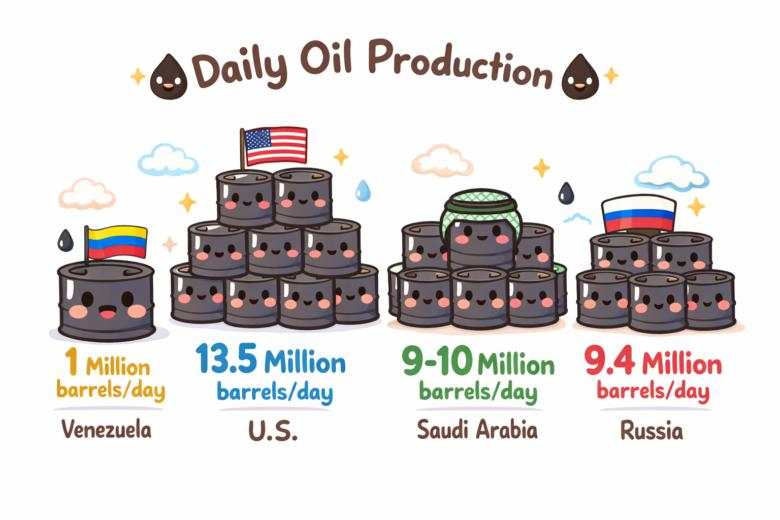 Compare Venezuela’s output to major producers:
- U.S.: 13.5 million barrels/day
- Saudi Arabia: 9-10 million barrels/day
- Russia: 9.4 million barrels/day
In a market this size, Venezuela’s daily oil production is a drop in a bucket. The country has huge reserves, but reserves don’t move markets, actual barrels flowing today do.
The Long-Term Picture: Why It Could Eventually Matter
Now, here’s where it gets interesting for traders thinking beyond next week.
If U.S. companies rebuild Venezuela’s oil sector, production could theoretically return to 2-3 million barrels per day within a few years. Some optimistic forecasts suggest 3-4 million barrels daily if everything goes perfectly. That would actually be significant new supply entering an already oversupplied market.
But there are massive obstacles:
- Infrastructure is devastated. Venezuela’s state oil company PDVSA estimates it would take $58 billion and many years to return to peak production. Pipelines haven’t been updated in 50 years. Refineries are barely functional. Wells have been shut improperly and damaged.
- Oil companies remember what happened before. Under Hugo Chávez in 2007, Venezuela nationalized the oil industry and forced out Exxon, ConocoPhillips, and others. No CEO wants to invest billions only to have assets seized again. Political instability makes this a huge risk.
- The timing is terrible for big investments. With oil prices below $60 per barrel and possibly heading to the $50s in 2026, the economics of spending billions on Venezuelan heavy crude look shaky. Many U.S. shale producers need $65+ per barrel to break even on new projects.
- Venezuela’s oil is difficult and expensive to process. It’s extra-heavy crude because it’s thick like molasses, high in sulfur and metals. You need complex refineries with cokers and hydrocrackers. Processing Venezuelan crude costs more than light sweet crude from Texas. In a low-price environment, that matters.
What to Watch Going Forward
If you’re trading or monitoring oil markets, here are the things to keep tabs on:
- OPEC+ meetings: They meet regularly to decide production quotas. In the current glut, they’re likely to keep output cuts in place. Any surprise production increase would send prices lower.
- U.S. production data: Weekly inventory reports from the Energy Information Administration show if American output is rising or falling. The U.S. pumps 13.5 million barrels daily, which means changes here matter more than all of Venezuela.
- China’s economy: The world’s largest oil importer. If China’s economy strengthens and oil demand rises, that could absorb some of the surplus. If China slows further, the glut worsens.
- Inventory levels: Watch for how much oil is stored on land and on tankers at sea. Rising inventories put prices under pressure. Some analysts warn we’re running out of storage space, which could force prices even lower.
- Venezuelan developments: Any concrete plans for U.S. companies investing would be news, but remain skeptical. This is a multi-year story at best, not a next-quarter story.
The Bottom Line
The Venezuela crisis is dramatic geopolitically, but it’s not moving oil prices because the market is already swimming in supply. Venezuela pumps less than 1% of global oil, and OPEC+ could easily replace every barrel multiple times over from spare capacity.
For beginner traders, this is an important lesson: Markets care about actual supply and demand, not headlines or potential. A country with massive reserves but tiny production doesn’t matter much today—no matter how big the military operation looks on TV.
Could this change long-term if U.S. companies successfully rebuild Venezuelan production? Sure. But that’s a 5-10 year story involving billions in investment, political stability, and companies willing to take enormous risks in a low-price environment.
Disclaimer: Trading and investing carry risk, and past performance does not guarantee future results. This article is for educational purposes only and should not be considered investment advice. Always do your own research and consider consulting with a financial advisor before making investment decisions. Seasonal patterns are observations, not predictions, and should never be the sole basis for trading decisions.

暂无评论,立马抢沙发