

You know that friend who always “forgets” their wallet when the bill comes? They promise they’ll pay you back, they swear they’re good for it, but after the fifth time, you’re like ehhhh… maybe I should stop lending this person money.
That’s basically the debasement trade, except the forgetful friend is the government, and instead of $20 for pizza, we’re talking trillions of dollars.
If you’ve been watching financial markets for the past two years, you’ve probably noticed gold hitting record highs, bitcoin rallying, and investors obsessed with “hard assets.”
Meanwhile, the U.S. national debt just cruised past $38.5 trillion like it’s got somewhere important to be.
Coincidence? Nope.
Welcome to the debasement trade—one of the oldest strategies in the book, now getting a 21st-century makeover. It’s not as complicated as it sounds, but understanding it might just save your portfolio when governments start playing fast and loose with the money printer.
What Is the Debasement Trade?
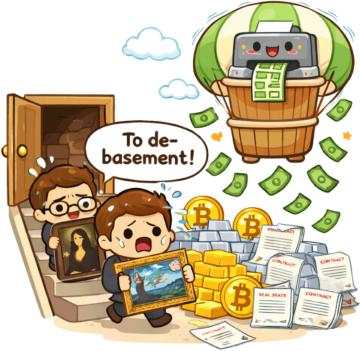 When investors think the government’s promise is becoming less reliable, they rush to own assets that governments can’t print more of.
The concept of “Debasement” can be traced back to ancient Rome, where emperors literally debased coins—mixing cheap metals with gold and silver to create more currency. Same coin, less actual value for each coin.
Modern governments don’t clip coins anymore. They do something infinitely less exciting – they expand the money supply digitally.
More dollars chasing the same amount of goods and services means each dollar buys less. Your $100 today might only have the buying power of $95 next year, or $90 the year after.
When investors sense this is happening—or about to happen—they flee to assets that can’t be diluted.
So, in times of uncertainty, investors tend to dump assets backed by government promises and buy stuff with a fixed, verifiable supply.
Assets backed by government promises can include fiat currencies (dollars, euros, yen), government bonds (Treasuries, gilts), savings accounts, or any investment denominated in paper currency.
Meanwhile, popular assets with finite supply can include commodities like gold and silver, bitcoin and certain cryptocurrencies, real estate, and even fine art or collectibles.
Debasement Trade in Action
Let’s say you’re holding $10,000 in cash and $10,000 in Treasury bonds. You’re earning 4% interest on the bonds, which sounds great until you realize:
- Inflation is running at 3-4%
- The government just announced another $27 bajillion spending package
- The Federal Reserve is buying bonds with newly created money
- Your “real return” (return after inflation) is basically zero—or negative. You’re treading water while your buying power slowly drowns.
So you sell those bonds and currency, and you buy:
- Gold: Up 60% – 65% in 2025 as inflation fears mounted
- Bitcoin: Which some see as “digital gold” with a hard cap of 21 million coins
- Commodities: Like copper or oil, which benefit from inflation
- Real assets: Property in stable markets with limited supply
You’re not necessarily getting richer. You’re just preserving wealth while paper assets lose purchasing power.
When Should You Consider Debasement Trades?
The debasement trade isn’t always “on.” Traders tend to watch for specific triggers:
Soaring Debt-to-GDP Ratios
When a country’s debt exceeds its economic output, it faces an ugly choice: default, cut spending dramatically, or inflate the debt away by making money worth less. Guess which option governments usually pick?
The U.S. debt-to-GDP ratio hit 123% in 2024. Japan’s is over 260%. These numbers are no joke and can make traders nervous.
Negative Real Yields
Remember that real yield = interest rate – inflation.
If 10-year Treasury bonds pay 4.5% but inflation is running at 4%, your real return is only 0.5%. If inflation ticks up to 5%, you’re losing money in real terms while taking on credit risk.
Negative real yields are rocket fuel for hard assets. Why lend money to the government at a loss when you could own gold or bitcoin?
Central Bank “Extraordinary Measures”
When central banks start buying massive amounts of government debt (quantitative easing), they’re creating new money to do it. The Federal Reserve’s balance sheet exploded from $4 trillion to $9 trillion during the pandemic.
More dollars in circulation = each dollar is worth less. Traders see this and head for the exits.
Currency Crises or Loss of Confidence
Sometimes it’s not gradual—it’s sudden. When the British pound crashed in 2022 after unfunded tax cuts, or when the Turkish lira collapsed amid political instability, the debasement trade went from theory to survival mode overnight.
Hedge the Macro Storm. Don’t just watch the debt-to-GDP ratios climb—act on them. Gemini is the first crypto-native exchange to offer CFTC-regulated prediction markets, allowing you to trade event contracts on the very macro catalysts driving the debasement trade. Secure, compliant, and built for the next cycle. Learn more about Gemini today.
Key Lessons for Traders
It’s about preservation, not speculation. The debasement trade isn’t a get-rich-quick scheme. It’s wealth insurance. When gold goes from $2,000 to $2,700, you’re not necessarily making money—you’re just not losing purchasing power while fiat currencies sink.
Timing matters—but it’s tricky. You don’t want to be early (holding zero-yield gold during a period of strong economic growth) or late (buying gold after it’s already up 50%). Watch the triggers above.
Diversification still applies. Even within hard assets, spread your bets. Gold has a 5,000-year track record. Bitcoin has a 15-year one. Real estate is tangible but illiquid. Mix accordingly. This isn’t new—it’s ancient. Every major currency debasement in history (Weimar Germany, Zimbabwe, Venezuela) saw the same pattern: people fled to hard assets. The specifics change, but the principle doesn’t.
Don’t fight the central bank—until you should. When monetary policy is tight and currencies are strong, the debasement trade underperforms. But when printing presses fire up and inflation fears rise, it’s time to reconsider your exposure.
The Bottom Line
The debasement trade is fundamentally a vote of no confidence in paper promises. When governments owe too much, print too much, or mismanage their economies, investors protect themselves by moving into assets with verifiable scarcity.
Right now, with global debt at record levels, persistent inflation fears, and geopolitical uncertainty, this trade is getting renewed attention. Whether it’s gold testing new highs, Bitcoin breaking records, or commodities rallying, the message is clear: investors are hedging against the possibility that today’s currency might not be tomorrow’s store of value.
Watch the debt numbers, monitor real yields, and pay attention to central bank balance sheets. When those warning lights flash, the debasement trade might be your lifeboat in a paper storm.
Interested in fundamental analysis made for newbies and how to pair it up with technical analysis to find high quality opportunities that may match your trading and risk management style? Check out our Premium membership for weekly & event analysis, short-term strategies, recaps and more!
BabyPips.com Annual Premium Members also get an exclusive 30% discount on the annual subscription for the first year on Tradezella–the top rated journaling app! ($120 in savings)! Click here for more info!

暂无评论,立马抢沙发