


Why Many Traders Choose to Step Aside on Christmas Eve
Given the risks of low liquidity and unpredictable movement, many traders choose to reduce exposure or stay out of the market entirely on Christmas Eve. This approach is often described as “sitting on hands” a disciplined decision to protect capital rather than chase uncertain opportunit
- brandymass1126 :I would like to know more about you Hope you don’t mind?
Low Liquidity, Wide Spreads, and Unexpected Price Swings
One of the biggest challenges during Christmas Eve trading is wider spreads. With fewer market makers and reduced trading volume, brokers often widen spreads to manage risk. This can increase trading costs and make short term trades less attractive. Another risk is unusual price swings, sometimes ca

- brandymass1126 :How are you doing now
Christmas Eve Trading: When the Market Quietly Changes Its Rules
Christmas Eve is a unique day for financial markets. While it may look calm on the surface, the trading environment quietly changes and that matters a lot for Forex traders. Many major financial centers such as Europe, the UK, and the US operate on shortened hours or close entirely, leading to a sha

What the Shift Toward EM Currencies Means for the Forex Market
The growing interest in emerging market currencies signals a broader change in Forex market dynamics. Instead of focusing only on major pairs like EUR/USD or USD/JPY, traders are expanding their view to include a wider range of currencies. This increases market depth but also introduces new sources

Carry Trade and Yield Search Drive Interest in EM FX
One of the key reasons behind the rising interest in emerging market currencies is the return of the carry trade. In simple terms, investors borrow funds in low yield currencies and invest in higher yielding ones to earn the interest rate difference. Many EM currencies currently offer attractive yie

Emerging Market Currencies Return to the Spotlight
Emerging market currencies have started to attract renewed attention in the global Forex market. As the US Dollar becomes more volatile, investors are increasingly looking beyond major currency pairs for new opportunities. This shift reflects a broader change in market behavior, where traders are be

How Yen Movements Could Shape the Next Phase of the Forex Market
Looking ahead, the yen’s path could influence not only USD/JPY but also the broader Forex market. If Japan moves closer to policy normalization, global investors may shift capital flows, potentially strengthening the yen and pressuring the Dollar. This scenario could also affect risk sensitive
What’s Driving Movement in the USD/JPY Pair Right Now?
USD/JPY has been one of the most active and sensitive currency pairs in the Forex market. Its movement is strongly influenced by the interest rate gap between the United States and Japan. When the Federal Reserve signals higher or steady rates, the Dollar often strengthens against the yen. When US y
Why Global Markets Are Closely Watching the Japanese Yen
The Japanese yen has become one of the most closely monitored currencies in global markets, especially as economic conditions shift and central-bank expectations evolve. Investors are paying attention because the yen often behaves as a measure of broader risk sentiment. When uncertainty rises across
What to Watch Next for AUD, NZD, and China’s Economic Outlook
Looking forward, the direction of AUD and NZD will depend heavily on whether China can stabilize its economic indicators. Stronger manufacturing activity, improved consumer confidence, or rising export demand could help support both currencies. But if China continues to show patchy or fragile growth

Why China’s Economic Swings Affect the Australian and New Zealand Dollars
The Australian dollar (AUD) and New Zealand dollar (NZD) are closely linked to China’s economic performance because both countries rely heavily on trade with China especially in commodities, agriculture, and raw materials. When China’s economic data weakens or becomes unpredictable
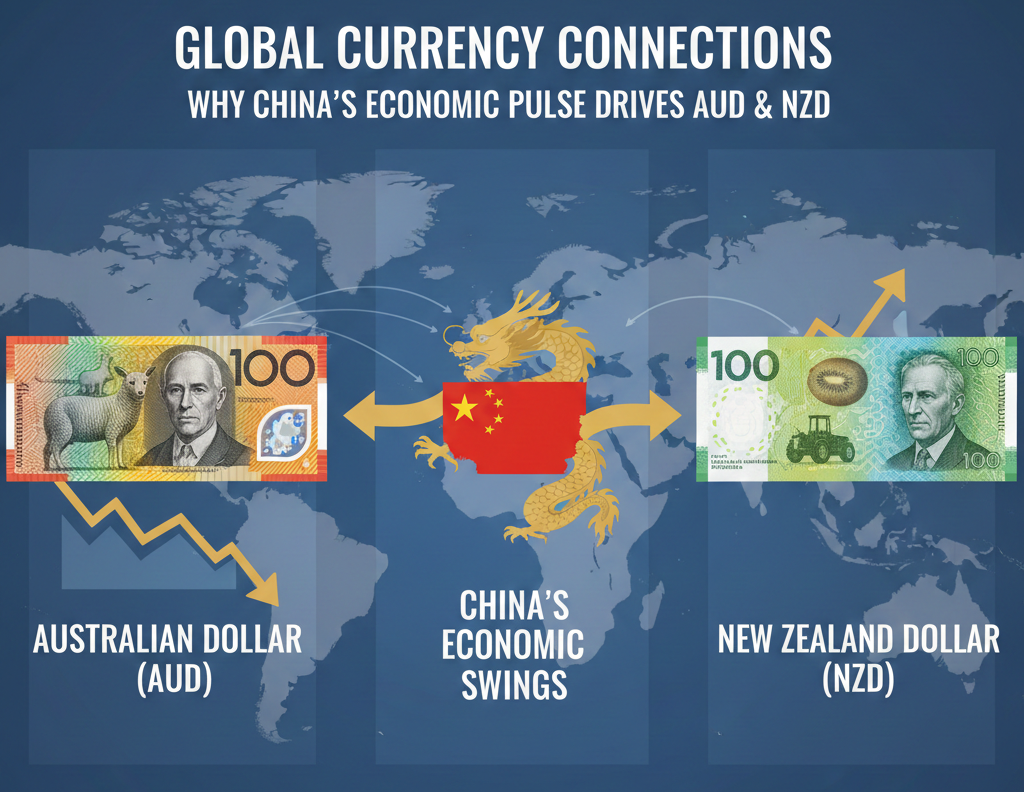
China’s Uneven Economic Data Continues to Shape Market Sentiment
China’s recent economic figures have remained inconsistent, creating uncertainty across global markets. Some sectors show signs of improvement, while others continue to soften, leaving investors unsure about the country’s growth momentum. This uneven performance matters because China is

The Road Ahead for Japan — Balancing Growth, Inflation, and Stability
Looking ahead, Japan’s economy faces a balancing act: maintain growth and support from domestic demand, while managing inflation and tightening monetary policy carefully. According to BofA, a modest but stable expansion is likely through 2026. If the BOJ moves ahead with gradual rate increases
BOJ Tightening Could Be Gradual — What That Means for Markets
Based on BofA’s outlook, the BOJ may start raising interest rates again possibly beginning in early 2026 provided inflation remains on a gradual upward path. BofA estimates the policy rate could reach around 1.5% by end of 2027, if underlying inflation and economic conditions support it. A gra

BofA Sees Japan’s Economy Staying on Track Into 2026
BofA recently raised its growth forecast for Japan’s economy forecasting 1.3% growth in 2025 and 0.7% in 2026. The bank expects this growth to come from stronger domestic demand: steady household spending and continued investment by companies. Even though exports remain weak due to global trad

正在加载中...
